
As part of the EMBL Entrepreneurial Minds series, organised by EMBLEM and EICAT, we welcomed Ilaria Ferlenghi, PhD, at EMBL Rome for her talk, “Beyond the Structure: My Journey through Science, Innovation, and Life Choices.” Following the event, we spoke with her about her career, her contributions to vaccine development, and the choices that shaped her journey.
Ilaria is a structural biologist and microscopy leader with over 30 years of experience, including more than 20 years in vaccine research and development. A pioneer in introducing cryo-electron microscopy into the pharmaceutical industry, she played a key role in the design and development of the BEXSERO vaccine. As Global Scientific Leader and Associate Director at GSK, she advances structural vaccinology and developed GEMINI, an AI/ML-based platform combining structural biology and artificial intelligence to accelerate the identification of potential vaccine antigens. She also co-founded WeInspireBio, a global initiative dedicated to inspiring and supporting the next generation of scientists.
In this interview, she reflects on scientific innovation, collaboration between academia and industry, and the professional and personal decisions that shape a career in science.
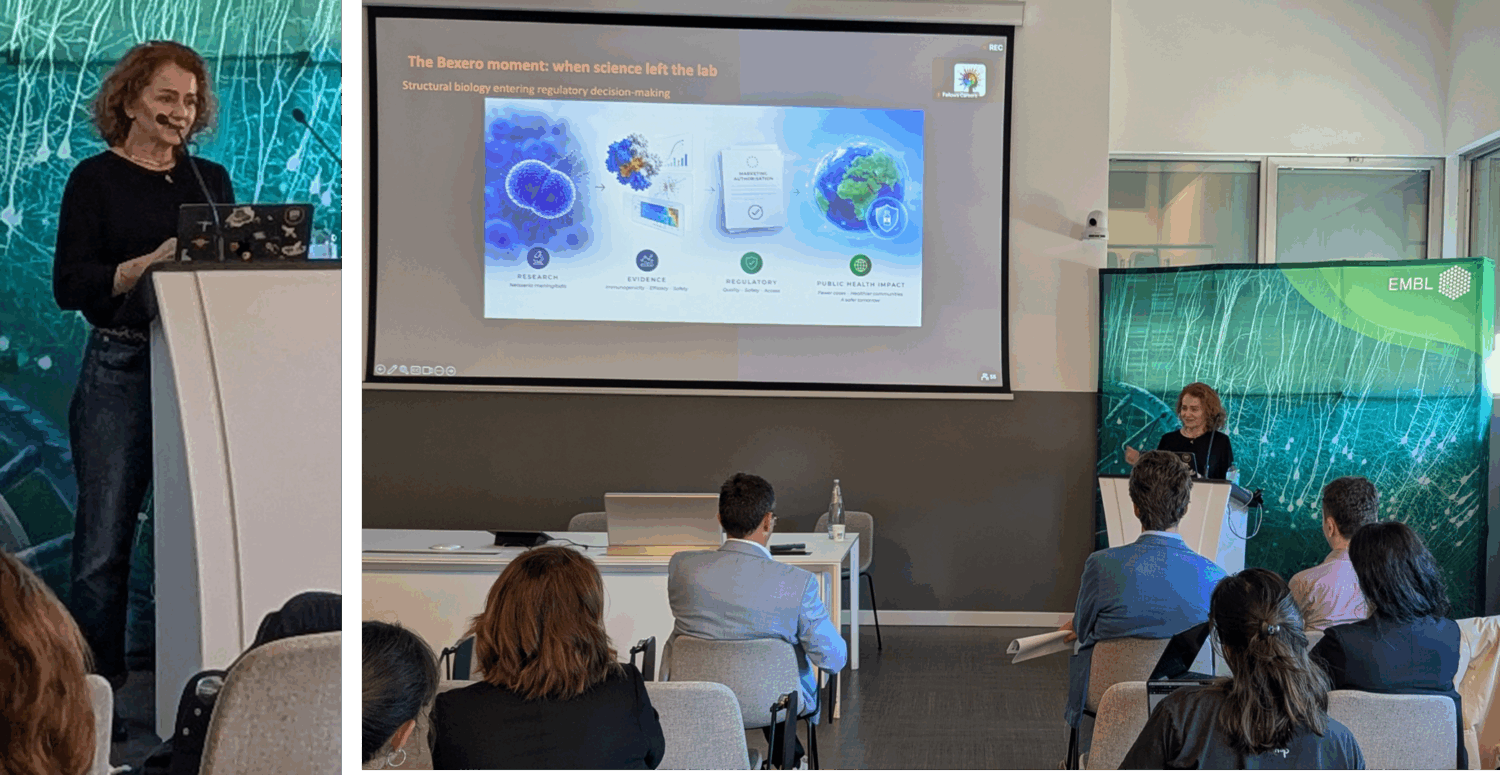
- What first attracted you to structural biology and microscopy?
I came from atomic physics and was fascinated by the idea of giving molecules a face, of actually seeing what they look like. That curiosity led me to interview for a position in the lab of Stephen Fuller, where I started working with electron microscopy, cryo-EM and structural biology.
- Your work brings together structural biology, advanced microscopy, AI and vaccine development. Could you briefly walk us through your career path?
I graduated in physics and then did my PhD at EMBL Heidelberg, working on cryo-EM. During that time, I started collaborating with Stephen Harrison at Harvard Medical School. What connected us was the pathogen rather than the technique itself. I later moved to Harvard and also spent time in Vienna with experts including Franz Heinz, broadening my exposure to structural biology and X-ray crystallography and moved to Paris to join the team of Felix Rey. At that point I had to decide whether to remain in academia or move to industry. I chose industry, first joining Chiron, then Novartis and later GSK.
- You have worked in academia and industry. What have you learned from each environment?
Every time I moved from one lab or environment to another, I learned a different way of thinking and working. You may use similar techniques, but the questions and the way you apply them can be very different. Academia gave me a strong basic-research mindset, which I brought into industry. Industry taught me to work much faster and to think in terms of a commonly shared project rather than a project that belongs to one person. In industry, your work is part of a larger ecosystem, and that constantly pushes you to adapt and improve.
- You helped introduce cryo-EM into pharmaceutical vaccine research. What potential did you see in the technology?
It was connected to an entrepreneurial mindset that I did not realise I had at the time. I always wanted to understand structure, and if I had a tool that could help me do that faster and closer to the native state, why not use it? That led me to push for a microscope in industry so that we could analyse molecules and antigens directly. It became a practical tool for screening molecules and thinking differently about vaccine design.
- What challenges did you face when bringing cryo-EM into an industrial setting?
A major challenge was convincing people that the investment was worthwhile. At the time, the head of Novartis Vaccines, Rino Rappuoli, who has always been a visionary scientific leader, was very open to exploring new technologies. I explained the potential of cryo-EM to him, and one of his first questions was simply: how much does it cost? We eventually brought in a microscope from Stephen Fuller at EMBL. That experience taught me that introducing a new technology is not just about buying an instrument. You also have to build the infrastructure, the expertise and the trust around it.
- What inspired you to develop the GEMINI platform?
Traditionally, vaccine discovery has relied on sequence information. But I had always been fascinated by what structure could reveal beyond sequence alone. After all, biology happens in three dimensions, and proteins that look very different at the sequence level can sometimes be remarkably similar structurally. As more structural data became available from X-ray crystallography and cryo-EM, I saw an opportunity to ask a new question: could we learn from structural similarity at scale and use that knowledge to discover relationships that sequence-based methods might miss? That idea became the foundation of a multidisciplinary effort combining structural biology and AI, and it eventually resulted in a patented methodology.
- How can AI and structural biology work together to accelerate vaccine development?
I start from the principle that molecules with similar or identical structures often have similar or related functions. If you can query a protein against proteins that have already been characterised, including known vaccine candidates, you can use that information to prioritise new candidates. AI can accelerate this discovery process and can also support the design of new antigens based on structural information.
- Where do you see the greatest potential for AI in pharmaceutical research?
AI can make research more focused, faster and more precise. It is not only useful for identifying candidates, but also for designing them and for dealing with the enormous amount of data we now generate. Its impact can span the whole pharmaceutical process, from discovery and development through manufacturing and regulatory activities. Increasingly, laboratories across these areas are becoming AI-assisted.
- Why is human scientific judgement still important as AI becomes more widely used?
Human validation remains essential. I am completely convinced that human feedback has to stay in the loop. The most effective approach is a continuous learning cycle in which AI and human expertise inform each other.
- What makes collaboration between academia and industry successful?
I still work closely with academia, and I see two main types of collaboration: those centred on a technique and those centred on a scientific project. In project-based collaborations, academia is particularly strong at bringing deep knowledge of the basic biology, the pathogen or the research question. Industry tends to be more application-oriented and pragmatic. The two are highly complementary. The best collaborations are those where the different expertise is brought together closely, almost as if everyone is working in the same kitchen.
- You contributed to the development of the BEXSERO vaccine. What did that experience teach you about turning research into real-world impact?
This was one of my biggest lessons in entrepreneurial thinking. Before BEXSERO, I was mainly generating structures at a research level. I then realised that creating real impact required building capacity around cryo-EM. It was not just about buying instruments. I had to learn how to make people trust the vision, align around a common focus, build leadership, secure resources and develop the different pillars needed to make the technology useful. I also learned much more about regulatory and manufacturing aspects of vaccine development.
- As a scientific leader, how do you balance long-term research with the need to deliver results?
Working in pharma helps because you are constantly pushed to generate new ideas in order to stay competitive, while at the same time investing in longer-term research. As a leader, you are also responsible for the activity of the whole team. You cannot be involved in everything yourself, so you have to learn what to delegate and to whom. Micromanagement does not work. Trust is key. I also found that, as a woman working in structural biology in industry, building that position and credibility could sometimes be more difficult.
- What motivated you to co-found WeInspireBio?
I wanted to have an impact not only through my own research, but also on the next generation. The co-founders initially came from industry, and we now also involve women from academia. We do not want the next generation of women scientists to limit themselves because of their gender. We organise events and mentoring activities, including scientific meetings focused on women in structural biology. There are still very few women in leadership positions in structural biology in industry, and we want to help change that. We also try to make the community genuinely inclusive and compatible with family life.
- What challenges do young scientists, particularly women, still face today when transitioning from academia to industry?
One challenge when moving from academia to industry is the perception that you will lose the freedom to do real science. In my case, that obstacle initially came from my own assumptions. On the industry side, there has also traditionally been a tendency to focus on more experienced scientists. In recent years, however, I have seen stronger investment in younger scientists, particularly because they are often very comfortable with newer tools such as AI and machine learning.
- How do you expect cryo-EM, AI and structural vaccinology to change vaccine research over the next decade?
I think the future will be increasingly integrative. One area I am particularly excited about is combining single-particle cryo-EM with cryo-electron tomography. With single-particle cryo-EM, we typically work with purified and stabilised antigens. But ultimately, an antigen is presented on the surface of the pathogen in the context in which the immune system actually sees it. Cryo-electron tomography, combined with AI and machine learning and supported by strong validation tools, can help bridge that gap.
- Which qualities have helped you build and sustain your career?
Curiosity has been fundamental, as well as being a very positive person. I was also raised in an international environment, with Russian, Italian and Austrian influences, so multicultural exposure has always been part of my life. And perhaps most importantly, I have never been very good at accepting “no” as the final answer.
- What advice would you give scientists who want their research to have a practical impact?
Be completely convinced by your ideas. Once you have developed an idea carefully and you believe it is valid, do not stop fighting for it. There will always be a need for new ideas. At the same time, keep looking for the environment that best fits your interests. That may be industry or academia, and you can move back and forth between the two.
- Anything else you would like to share with us?
EMBL is a very special environment in which you can build friendships and collaborations that last for decades. Some of my closest friends are people I met there more than 20 years ago and who are still part of my life. EMBL is also still a place I turn to when I want feedback from a basic-research perspective. That combination of science, friendship and long-term collaboration has stayed with me throughout my career.
We sincerely thank Ilaria for her inspiring talk and for taking extra time to engage with the audience during the networking break and roundtable discussion. We also warmly thank EMBL Rome, Cornelius Gross, Neeya Jacob, Rosana de Lorenzi, Angela Quaglietta, Sara San Roman and Massimiliano Ceccarelli for their support in making this seminar a success.
Related links
- Dr. Ilaria Ferlenghi
- Webinar Recording